Recently while going through some old family items, my wife came across a 1956 issue of Argosy magazine. Now, you've got to be near or beyond retirement age to even remember Argosy so, if you're younger than that, it was a popular mens' magazine that began publication in 1882. It finally went the way of the Dodo bird in 1978. If you do a little research on it, you'll find that over the years the magazine has had some well-known writer's stories. Horatio Alger, Upton Sinclair, Zane Grey and Edgar Rice Burroughs are among the more notable contributors.
What piqued my interest as I flipped through the aging pages wasn't the stories of Russian cold war defectors or the dangers of hunting wild water buffalo in Brazil. The thing that got my attention were the ads for outdoor gear. Mitchell Model 300 spinning reels with extra spool, a new fangled fiberglass rod, rod sack and aluminum tube for only $34.70. If you didn't have $34.70 to spare, just send them $2.00 as a down payment and take 6 months to pay the balance.
Stevens Model 77 pump shotguns at $49.95. Genuine Paratrooper Boots for $14.87, postpaid in the U.S.A. A Smith & Wesson .38 Revolver, WW II issue, for $24.95. And my favorite of all time, Shrunken Heads straight from the Amazon for only a buck fifty ppd.
The best ad in the magazine that got every angler's attention, however, had to be the one for Pflueger Reels. The good old Medalist was selling for $8.50. In today's dollars, that translates to $70.82. I've always been enamored with the Medalist. The smooth hefty feel and that sound. Man, that solid "click, click, click" is as distinctive as the old two-cylinder "Poppin Johnny" John Deere tractor. Some things just conjure up images of the past and a Pflueger Medalist is one of them.
Tuesday, May 14, 2013
Friday, April 12, 2013
Chestatee Tribs
Posted by
Lee
at
4:41 PM
Our ol' pal Landon Williams should have been studying for tests on Sunday, but instead did what any self-respecting fly-fishing student would do: went fishing! Here's a brief report:
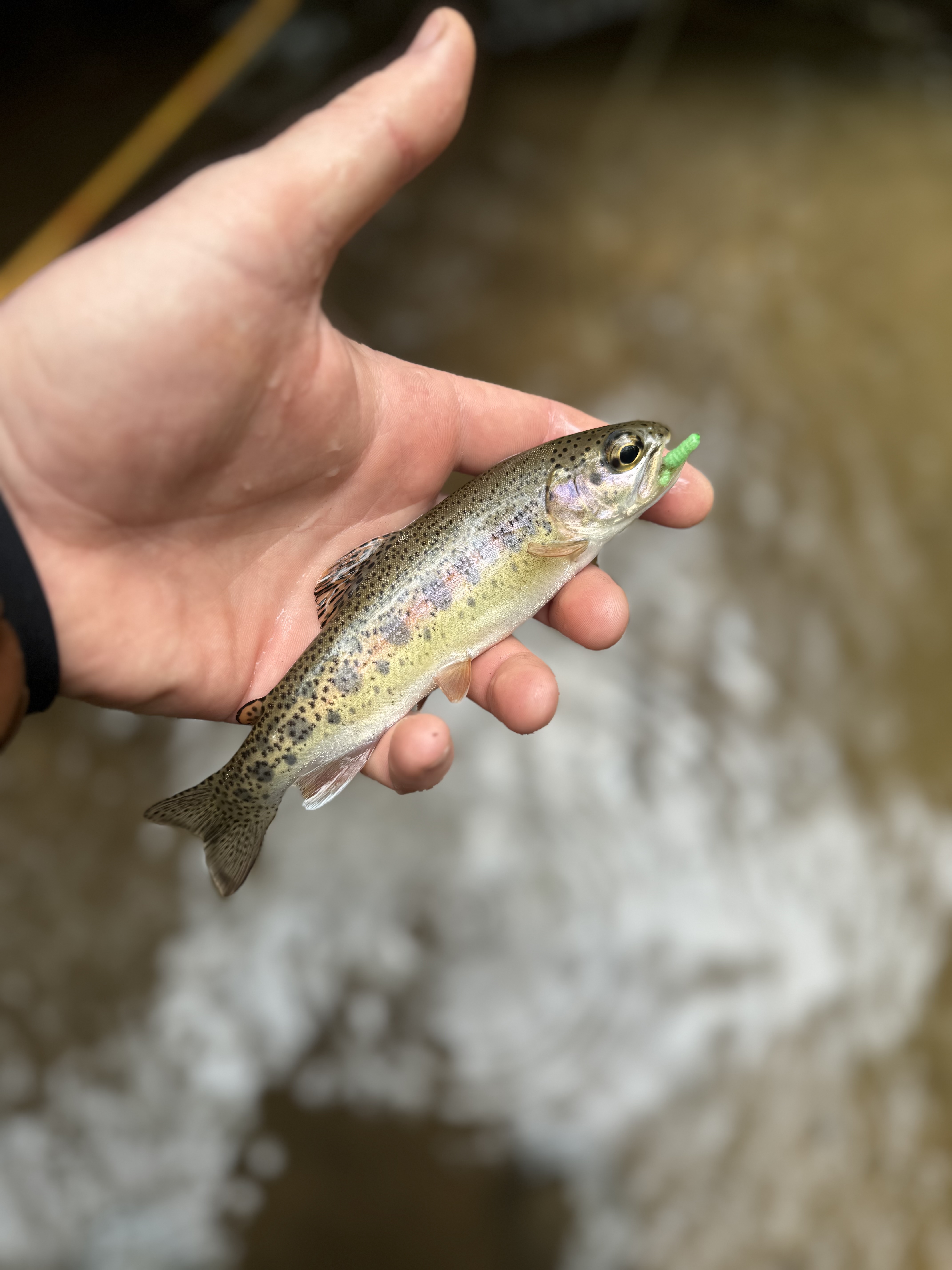
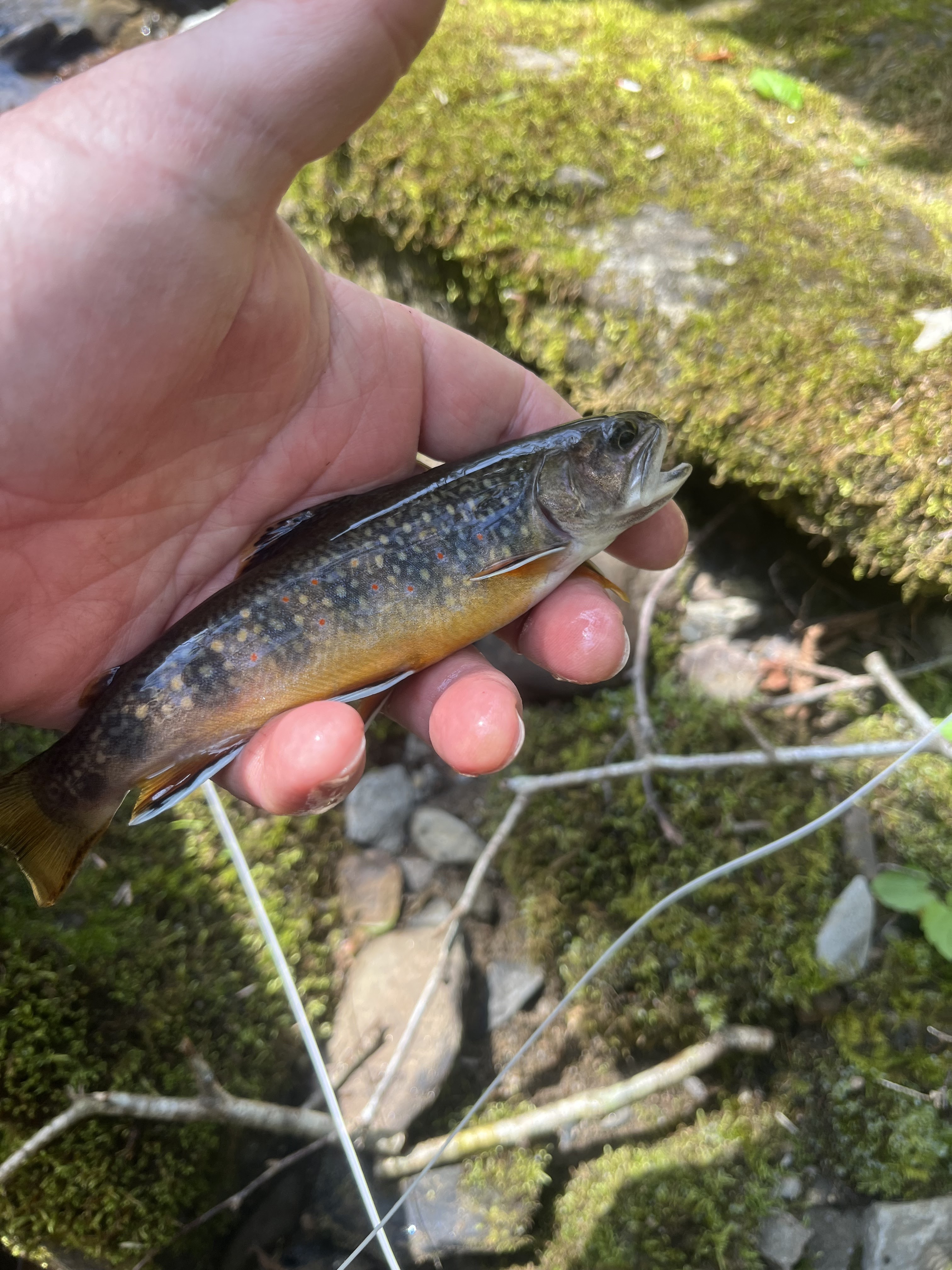
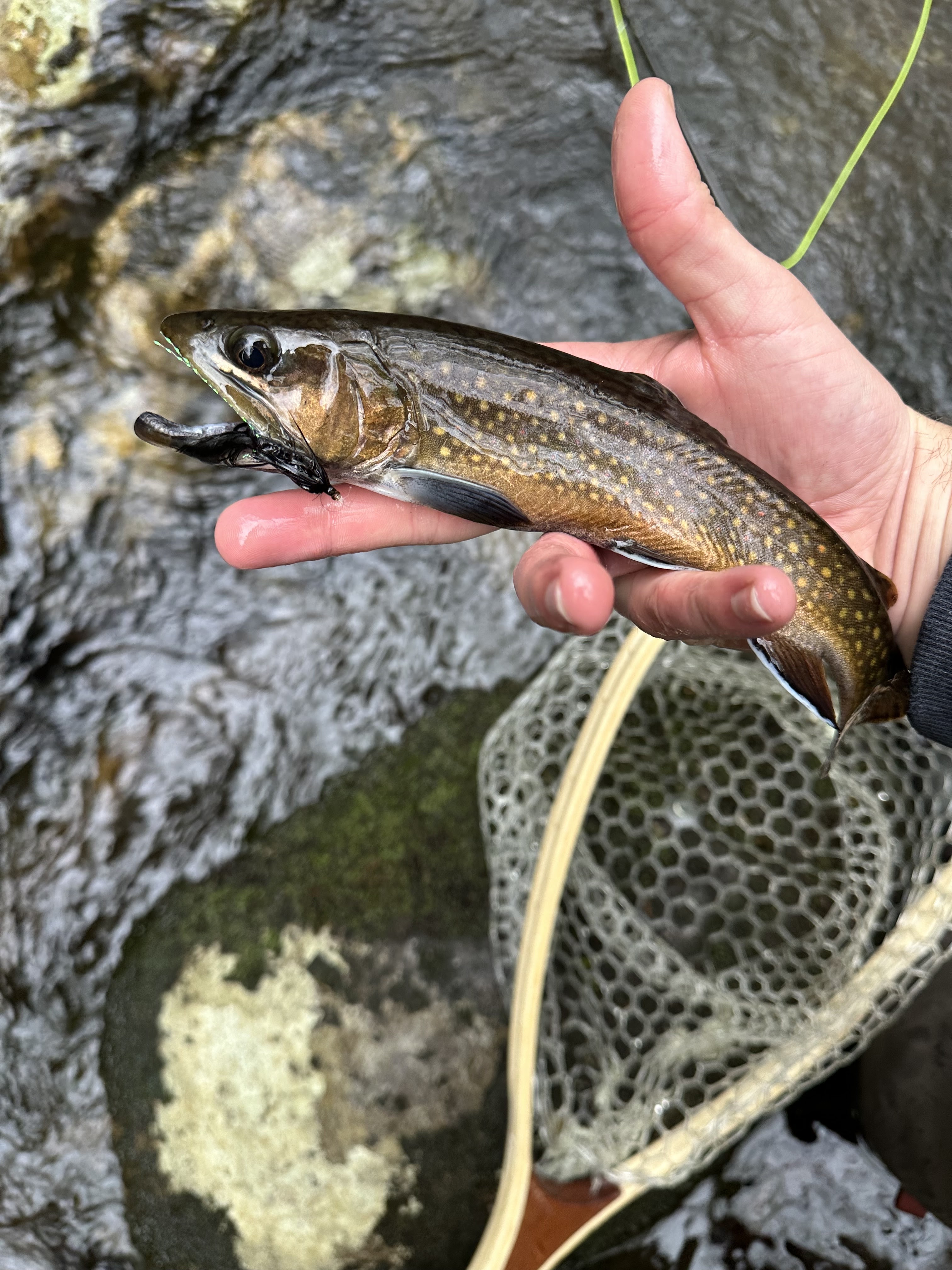
I fished some Chestatee tributaries on Sunday just for a quick fix before I went back to studying for the day. Air temps and water temps were just about ideal with water temperatures ranging from 49-53 all day depending on the tributary and shade. Bug were hatching from about 10 am on and were thick all day. There were not real large numbers of any particular kind but mayflies seen included size 14 March Browns, 14-16 Hendricksons, and grey and black caddis around a size 14-16. I dredged really early before the sun came up real well on a certain trophy regulations stream with good results but caaught a lot on a 14 yellow stimulator and 14 Parachute Adams but caught just as many on a 16 tungsten bead hares ear 2 ft on a dropper rig once I hit tributaries for wild fish. Enjoy the pics.
Signed,
Test cramming cretin.
The creeks will be a little high with all the rain we've had the past couple days, but the above-average temps should really have the fish active - should be a great weekend on the water!
I fished some Chestatee tributaries on Sunday just for a quick fix before I went back to studying for the day. Air temps and water temps were just about ideal with water temperatures ranging from 49-53 all day depending on the tributary and shade. Bug were hatching from about 10 am on and were thick all day. There were not real large numbers of any particular kind but mayflies seen included size 14 March Browns, 14-16 Hendricksons, and grey and black caddis around a size 14-16. I dredged really early before the sun came up real well on a certain trophy regulations stream with good results but caaught a lot on a 14 yellow stimulator and 14 Parachute Adams but caught just as many on a 16 tungsten bead hares ear 2 ft on a dropper rig once I hit tributaries for wild fish. Enjoy the pics.
Signed,
Test cramming cretin.
The creeks will be a little high with all the rain we've had the past couple days, but the above-average temps should really have the fish active - should be a great weekend on the water!
Thursday, April 4, 2013
The Best Spring Break!
Posted by
Jimmy
at
9:19 AM
I called it quits and headed north to Great Smokey Mountains
National Park in the hopes for even more scenery and wild trout. I camped two
nights at Smokemont and this last half of the trip was exactly what I had in
mind for the whole trip. Winter Stoneflies and a few Quill Gordons were even
dancing for me on arrival. However it was apparent after flinging various dry
flies with meager results that the fish were just not looking up on Saturday. I
think this was in large part due to the fact that the water temperature topped out at a still
fairly low at 46 degrees. I
reluctantly went back to dredging and salvaged the last few hours on my same
Davidson rigs from the day before.
My trip was
great, but there were three things that I came away with:
- Always adapt to changing conditions.
- Keep an eye on that water temperature.
- San Juans work very well, despite what locals say!
Landon Williams
Tuesday, March 26, 2013
Flint River Needs Your Help
Posted by
Jimmy
at
9:12 AM
![]() | ||
|
Tuesday, March 12, 2013
Wild Trout Primer
Posted by
Lee
at
5:00 PM
From our ol' pal Landon Williams:
In case you haven’t heard, Georgia's trout season opening day is less than three weeks away!
Perhaps the most useful tool that one can acquire for researching wild trout streams is a quality map of the Chattahoochee National Forest. There are many maps that not only show the forest service roads but also many of the streams and their names as well. My personal favorite can be found by clicking here and the different areas of the forest can be accessed by clicking on the map. The digital copies are nice but an actual in-hand copy is invaluable when you are out and about actually looking for the streams. For those who are more adventurous and familiar with the technology, GPS units are also handy when you get way off the beaten track, as you often do with this type of fishing.
Aside from finding the streams, there are a few things to remember in your search. Rainbows and browns are the most likely trout you are to encounter in our trout streams here in North Georgia. They are quite numerous and can prosper in streams even at relatively low elevations. There are not many streams predominated by brown trout, but they do exist, especially at the lower elevation (1500 ft. or so) and lower gradient streams. Rainbows tend to take over as the water speed and gradient of the stream increase. Both species certainly do mix but these are generally good trends to follow if you are also following along with your research with a topographic map featuring elevations.
If you are interested in the highly coveted Brook Trout, generally the angler will have to go much higher up in elevation. This is not necessarily due to their demands for colder water but in large part due to being outcompeted by invasive rainbows and browns. Brookies are usually found in sections of streams located above large waterfalls that inhibit the movement of rainbows and browns into their sections of water. Many regular brook trout anglers are convinced that a section of water located above a “barrier falls” and 2500+ ft. in elevation is the formula for finding brook trout regularly. Also of interest are the “Back the Brookie” streams that have received stream enhancement projects from TU, GA DNR, and the Forestry Service. They are a great starting point, especially for new wild trout anglers.
Good luck in your research efforts in the coming weeks. The wet winter that we have had should have stream levels in great shape for this spring!
Thursday, March 7, 2013
Gearing Up For Spring
Posted by
Lee
at
11:05 AM
Chuck Head got in a bit of fishing this week and he's fired up about the spring:
As surely everyone has noticed, we have actually had a winter in southern Appalachia this year. Unlike the last couple of dry and relatively warm winters, this year gave us more than a couple of good snows, and a few pretty incredible floods. This is often seen as an inconvenience, with favorite rivers swollen and unfishable for over a week at a time, leaving anglers with few options within a reasonable drive from home. However, there is a longer term payoff to the angler in exchange for a few more weekends spent at the tying desk or watching a favorite fishing DVD for the fifteenth time.
All of that high, cold water has done an incredible job of making our water look better than it has looked in a decade. Years worth of silt deposits have been flushed away, leaving the water to run clear and cold over rock instead of sand. This is a very good thing for the insects that populate the stream bottom, which, in turn, benefits the trout. The fish have eaten well all winter, have fought hard when hooked, and look bright and well fed when held and released. Standing high on a bank on the Hooch or at Dukes, watching the big boys feed, sliding actively back and forth, they look, for lack of a better word, happy. Plenty of food to eat and plenty of water over their heads: about as much as a trout could ask for.
So what does all of this mean to the angler getting ready to head to the stream after being washed out this winter? I would say the key to consistent angling success this Spring is to adapt to conditions on your "new" home waters. If you haven't gotten a chance to get to your favorite stream this Spring, I'll go ahead and tell you - it looks different than it did last Spring, and better. Something some anglers don't realize is that high water events can change the way a stream looks and fishes completely. It doesn't matter if a favorite pool produced well last Spring, there may only be one or two fish calling it home this year, if that spot is even there at all. Floods change streams. I always tell people to fish where there should be fish, not where success was had in the past. Fish have no emotional ties to a spot in a stream, and as soon as it stops producing what a fish needs in terms of food and shelter, it will leave without as much as a kiss goodbye.
Another large part of success this Spring will lie in the angler's ability to get the flies in front of the fish. More water means more weight. Last Spring, I remember fishing one of my favorite spots with a single #1 split shot, while currently it takes four BB shot to get down to the fish. Having flies in front of the fish is more important than the flies themselves; they can't eat what they never see. Once down, flies with movement, color, and/or flash are a good way to get the fish's attention in the higher water. That fly is moving past the fish much faster than it was last Spring, so something needs to jump out at them. Using a Rubberlegs, San Juan, or a Lightning Bug type fly in front of a more natural trailing fly (Hares Ear, Pheasant Tail) is a good way to get a fish in line with your drift and then give the fish a choice of which fly he wants.
![]() |
| This egg heavy female smashed a large crawfish pattern drifted deep through a prime looking run. |
All of that high, cold water has done an incredible job of making our water look better than it has looked in a decade. Years worth of silt deposits have been flushed away, leaving the water to run clear and cold over rock instead of sand. This is a very good thing for the insects that populate the stream bottom, which, in turn, benefits the trout. The fish have eaten well all winter, have fought hard when hooked, and look bright and well fed when held and released. Standing high on a bank on the Hooch or at Dukes, watching the big boys feed, sliding actively back and forth, they look, for lack of a better word, happy. Plenty of food to eat and plenty of water over their heads: about as much as a trout could ask for.
So what does all of this mean to the angler getting ready to head to the stream after being washed out this winter? I would say the key to consistent angling success this Spring is to adapt to conditions on your "new" home waters. If you haven't gotten a chance to get to your favorite stream this Spring, I'll go ahead and tell you - it looks different than it did last Spring, and better. Something some anglers don't realize is that high water events can change the way a stream looks and fishes completely. It doesn't matter if a favorite pool produced well last Spring, there may only be one or two fish calling it home this year, if that spot is even there at all. Floods change streams. I always tell people to fish where there should be fish, not where success was had in the past. Fish have no emotional ties to a spot in a stream, and as soon as it stops producing what a fish needs in terms of food and shelter, it will leave without as much as a kiss goodbye.
Another large part of success this Spring will lie in the angler's ability to get the flies in front of the fish. More water means more weight. Last Spring, I remember fishing one of my favorite spots with a single #1 split shot, while currently it takes four BB shot to get down to the fish. Having flies in front of the fish is more important than the flies themselves; they can't eat what they never see. Once down, flies with movement, color, and/or flash are a good way to get the fish's attention in the higher water. That fly is moving past the fish much faster than it was last Spring, so something needs to jump out at them. Using a Rubberlegs, San Juan, or a Lightning Bug type fly in front of a more natural trailing fly (Hares Ear, Pheasant Tail) is a good way to get a fish in line with your drift and then give the fish a choice of which fly he wants.
Wednesday, February 27, 2013
Monster Smallies
Posted by
Jimmy
at
11:06 AM
I've known Steve Hacker for a number of years and get to fish with him now and then on his home waters in north Alabama. Steve is probably the foremost smallmouth guide in the region and knows those lakes as well as anyone who's ever fished them. I get regular fishing reports from him but this most recent was so good I thought our readers would enjoy reading it.
Jimmy
PICKWICK FISHING REPORT
2.25.13
Water temp: 48.2 degrees
TVA discharge rate: spillways reopened; approx. 104,000 cfs/24 hr. period.
Lake elevation: risimg; approx. 419
Pinching myself to make sure that I'm not just having a dream about a day full of giant fish! Mat Lipscomb came over from the Memphis area and met up with former Memphis State college roommate and good friend Rick Benson. Having known both of them for years, I was really looking forward to the day. Little did we know when we launched what kind of day it would turn out to be!
Mat was the keeper of records, as he brought two sets of Chatillon scales with him, and a piece of paper and pen to keep track of what we caught. The first place we fished yielded nothing, but a move proved to be just what we needed.
Our five best today weighed in at almost 32 pounds! Our 10 best liked 2 ounces weighing 53 pounds! Each of us contributed big fish and had something to crow about!
Rick had the big fish at 9-1, a magnificent largemouth, his personal best. Mat had the big smallmouth, I think equaling his personal best, Rick had the big spot, and Mat said that I had the best 5 fish individual string of the three of us at 25-10.
We had a Grand Slam of smallmouth, largemouth, and spot—3 fish Slam—that weighed 17-11! Rick had a Grand Slam by himself that weighed 16-8! Where else can you do that? What a lake!
A couple of fish were caught early on on jerkbaits, but the great majority of the fish were caught on Strike King Pro Model Football Jigs in ½ and ¾ oz weights trailed with Rage Craw trailers. Even after washing and eating supper, my fingers still smell like Kick'n'Bass Craw, and that's just fine with me.
Greatly blessed we were today, as the weather and water conditions were pretty rough, and getting rougher as I write (I can hear the thunder approaching in the distance, and some storms with even bigger winds than the 20-25 mph we had today are forecast for tonight).
Enjoy the pix, and all the fish were released in great shape just as soon as we took these. A replica mount of the big 9-1 is planned.
God bless,
Steve Hacker
www.smallmouth.com
Jimmy
PICKWICK FISHING REPORT
2.25.13
Water temp: 48.2 degrees
TVA discharge rate: spillways reopened; approx. 104,000 cfs/24 hr. period.
Lake elevation: risimg; approx. 419
Pinching myself to make sure that I'm not just having a dream about a day full of giant fish! Mat Lipscomb came over from the Memphis area and met up with former Memphis State college roommate and good friend Rick Benson. Having known both of them for years, I was really looking forward to the day. Little did we know when we launched what kind of day it would turn out to be!
Mat was the keeper of records, as he brought two sets of Chatillon scales with him, and a piece of paper and pen to keep track of what we caught. The first place we fished yielded nothing, but a move proved to be just what we needed.
Our five best today weighed in at almost 32 pounds! Our 10 best liked 2 ounces weighing 53 pounds! Each of us contributed big fish and had something to crow about!
Rick had the big fish at 9-1, a magnificent largemouth, his personal best. Mat had the big smallmouth, I think equaling his personal best, Rick had the big spot, and Mat said that I had the best 5 fish individual string of the three of us at 25-10.
We had a Grand Slam of smallmouth, largemouth, and spot—3 fish Slam—that weighed 17-11! Rick had a Grand Slam by himself that weighed 16-8! Where else can you do that? What a lake!
A couple of fish were caught early on on jerkbaits, but the great majority of the fish were caught on Strike King Pro Model Football Jigs in ½ and ¾ oz weights trailed with Rage Craw trailers. Even after washing and eating supper, my fingers still smell like Kick'n'Bass Craw, and that's just fine with me.
Greatly blessed we were today, as the weather and water conditions were pretty rough, and getting rougher as I write (I can hear the thunder approaching in the distance, and some storms with even bigger winds than the 20-25 mph we had today are forecast for tonight).
Enjoy the pix, and all the fish were released in great shape just as soon as we took these. A replica mount of the big 9-1 is planned.
God bless,
Steve Hacker
www.smallmouth.com
Wednesday, February 20, 2013
Brown Trout Tactics
Posted by
Jimmy
at
2:34 PM
From our Man In The Field, Landon Williams:
There
is just something about Brown Trout that get many anglers’ hearts racing and a
large grin on their face. We all dream of catching a large hook-jawed brown that seems as old as the dinosaurs. They are for many, the most prized and even most frustrating
species of salmonid we can pursue here in the Peach State. Despite our fascination with them, it’s a surprise to many anglers when they do catch one. This is due in large part to the varied habitat that brown trout prefer and the tactics used to target them.
There are three types of habitat that can be noticeably
improve your chances of running into a nice brown trout, whether it be a
Delayed Harvest fish or an elusive stream-born wild fish. The first and, in my opinion,
most important structure a brown trout will utilize are undercuts. Undercuts
exist here in GA quite often but not in the same sense you may think of in a
meandering meadow stream with undercut banks out West. Rather, I'm referring to large undercut
rocks and my favorite, bedrock shelves. It is quite common to find brown trout
hiding under such types of habitat, even if it is not particularly deep.
Last but not least are those bank side pockets and runs that
many anglers often ignore. Current
along the bank is usually quite slow compared to the middle sections of river. Brown trout, who are fans of slower
current, can be found in runs and riffles right next to the bank, especially if
they have overhead cover in the forms of bushes or overhanging trees. This
habitat type is even better if they incorporate any of the two previously
mentioned attributes.
Landon
Browns
have a tendency of not being in the places many anglers expect when
targeting trout. Most anglers will fish in the classic riffles and runs that we think of as great trout
habitat. You can certainly find brownies in these spots when they are actively
feeding, especially when there are heavy hatches during warmer weather. However, you are much more likely to find browns in the water you may find much less desirable to fish on a regular basis. You know the type, usually deep and slow interspersed with
structure such as woody debris and large boulders. This is indeed the type of
water where you’re most likely to encounter a brown. At the same time, this water may be the one where
anglers are least likely to be successful. Slower water gives an angler's quarry much longer to inspect the fly before deciding to eat or not. This game for some can be quite exciting
and challenging but for many anglers, who are just out to catch a few
fish, it may seem it's not worth the effort. Fear not however, as there are a few key areas where brown
trout get the same type of protective habitat while still having more water
flow over their heads and it can tip the scales in the angler’s favor.
A second type exists less frequently but still provides
great habitat. It's a back eddy. Back
eddies are usually slow and provide a large volume of food as it drifts away
from the main current. It is not uncommon to find browns here and they can be
targeted by casting into the “upstream” side of the back eddy (this may even
mean casting downstream into the eddy’s current and fishing the drift back
upstream.)
Fly selection in itself is secondary to having the proper
presentation and a sneaky approach to your target area and quarry. Good Luck and have fun in your quest for
a trophy. I know I will when I go
after the large wild brownie who broke me off recently in a
log jam!
Landon
Tuesday, February 19, 2013
Happy Birthday To You
Posted by
Jake Darling
at
3:29 PM
Growing up, my parents always made sure I understood that a man must always keep his word, and that he should never make a promise that he did not intend to keep. My parents' words bounced around in my head as I laid in the warm bed Sunday morning, wondering how mad my friend would be if I backed out on him on his birthday float trip. Then as I lay there in bed, another phrase popped into my head that my Father would always say: "You never know, unless you go". This was his way of telling all the people who asked him if he honestly thought that he was going to catch fish in extreme weather conditions.
Knowing that the high for the day was only supposed to be around 38 degrees, I slowly climbed out of bed and began to get ready, knowing that I had made a promise that I intended to keep. As we drove to the river, I began to ask myself if I was mentally prepared to freeze my butt off and not catch any fish.
We arrived at the river and prepared to set sail on what could be the most miserable day that I had faced this year. We launched the boats and managed to get enough of the frozen anchor rope out to hold the boats in place until we returned from our shuttle. After putting on every piece of clothing that I had brought with me, we departed down the river. In the first mile of the trip, I quickly changed my opinion about how the day was going to be, as we began to pull fish after fish into the boat. Not only were we catching fish, but we were catching quality fish, with the average being around 17 inches. As luck would have it, Ryan Williams managed to put the first fish in the boat on this particular trip, which was only fair, since it was his Birthday.
![]() |
| Ryan With A Quality Rainbow |
The boys in the boat behind us were not going to be outdone by a bunch of young guns, and immediately responded with a stud of a brown trout. We all stopped fishing and turned around to watch Mike wrestle with what he called: "The biggest brown he had been hooked into since his trip to Montana last year". The fish ran in and out of trees and tried his best to lose Mike, but Mike's expertise eventually brought the brute into the boat.
![]() |
| Mike's Big Brown |
As we continued to float down the river, we experienced what I will remember as one of my best days on the Toccoa River. Some days you put up numbers some days you put up size, but on this day we did both! I'm sure that Ryan couldn't have thought of a better way to spend his birthday, now I just have to talk him into rowing me down the river on my birthday. Happy Birthday Bud!
Monday, January 28, 2013
Fishing Rising and Falling Water Conditions
Posted by
Jimmy
at
10:39 AM
With all the rain we've experienced over the past couple of weeks, we thought we would ask Landon Williams to be our guest blogger and help you understand how we continue to catch fish even under adverse water conditions.
How to Deal With the “Rise” and “Fall” of Winter Weather
Landon Williams
The monsoon of last week may be
over but our rivers and streams are just now starting to get back to
recognizable flows. Fishing when the water is lower is always less demanding
physically but when it’s high from events such as the recent rain, conditions
can not only be unfavorable for the fishing but also dangerous with the raging
water and decreased visibility. However, there are the periods of rising and
falling water that provide very challenging and sometimes even rewarding
fishing conditions in themselves.
| Raging Dukes Creek - The Swimming Hole |
| Dukes Creek Bow in High Water |
| Finding the High Water Refuge |
More importantly, keep yourself safe when wading this time
of year. Wear a wading belt, use a staff, and fish with a buddy if possible.
Also keep an extra pair of warm clothes at hand in case of a dunking. Perhaps
most importantly, have a camera… Just in case!
Tuesday, January 15, 2013
Meetings on Corps of Engineers Plans to Close Six Tennessee Tailwaters
Posted by
Lee
at
12:32 PM
|
Monday, January 14, 2013
Did You Make It To The Chattooga This Weekend?
Posted by
Jimmy
at
8:08 PM
![]() |
| Hey, anyone can hook a fish in the mouth! |
![]() |
| A Black Elk Hair Caddis will match the Stoneflies |
It's raining almost every day this week and things are expected to turn colder but this is prime time on the Chattooga DH. If you can get away, and the water level is 2 feet or less, you need to plan a trip there. And you may want to pack some Pat's Rubber Legs.
Tuesday, January 8, 2013
From the Tennessee Wildlife Federation
Posted by
Lee
at
3:35 PM
|
Sunday, December 30, 2012
Hat Trick on the Chattooga
Posted by
Lee
at
7:31 PM
This just in from Nanook of the North...
Our Georgia folks oughta take advantage of the DH program, especially if the Hooch Tailwater is still fishing tough for a few more days until the Lanier turnover is finished. The Chattooga provided the hat trick yesterday, with a bunch of rainbows, three brooks, and a brown being "fondled".
TV weather reports seem to scare off many Georgia trouters, but they often do not accurately describe the true fishing conditions of our winter waters. Instead, a) weather radar and hourly forecasts on web weather sites like Intellicast, b) the USGS "Real Time" website's stream gauge data (water temp and flows), and c) good friends at local tackle shops or fishing clubs like TU and NGTO, are much better "strike indicators" to help folks decide whether to burn their time and gas on a trek north. We seasoned dudes call this "net fishing," as we fish the inter-net the night before we decide which stream, if any to visit.
Another important tip: it's winter fishing season and Georgia trouters should consider adapting their techniques to the season and the higher water flows. I would encourage anglers to lengthen their leaders (better yet, use straight mono or fluoro) to the maximum length they can handle, and add enough shot to get their offerings down. The flies need to cut through the water column and scrape along the bottom. Thick leader butts and midsections are counterproductive at this time of year, as the heavy flows catch that thick stuff and and drag an angler's flies quickly away from the bottom-hugging fish. If anglers still want to use tapered leaders, they should at least add 3-6 feet of 3X to the ends of those 7 or 9-foot leaders, then add their tippet and flies. Tapered leaders aren't needed to cast flies, as the slingshot effects of lead do a fine job!
I've seen this quote in enough fly fishing books and it rings especially true now, as we welcome the new year:
"The difference between a good day fishing and a great day fishing is one more split shot."
My rig yesterday was about 12 feet of 8 pound mono, a large, sliding cork strike indicator (Lightning Strike brand, with hole thru the middle) that was usually within a couple feet of the fly line, 18 inches of 4X to the #10 leech, and 18 inches of 5X from the leech's hook bend to the #18 pheasant tail. I used one to three removable, size BB split shot above the knot at the 8lb/4X junction. Shot numbers and indicator location (2X water depth) on the leader were changed to accommodate each pool. A rubber band or toothpick made the indicator adjustment quick and easy. An occasional bounce of the indicator told me when I found the "tick-tick" of a good drift along the bottom. And an upstream-lunging indicator told me that a fish agreed!
For new folks, the shallower heads of pools are easier to fish. They don't require as much leader length, which makes casting easier. I like traditional casting, but I like catching even more. I'll return to casting around March, when the water warms, the bugs get frisky, and the fish start looking up again. Right now, I use short casts with roll casts, water loads, and an occasional Belgian backcast (thanks to Hoover Burrell) to put the rig in the water with zero or few false casts and very, very few tangles.
There is no one "right way" to fish, but maybe this method will add to the arsenals of our newest trouters and help them "grip-n-grin" some more this season. Then they can "pass it on" to the newbies that they meet. More tips here.
The fish are there. They are hunkered down, but still hungry. Georgia trouters oughta put a disposable handwarmer pad on top of their toes, in between two pair of wool socks, slip into their waders, and go get 'em!
Happy New Year,
Nanook
Ed. Note: After this post was published, we had folks asking for a detailed description of how to rig the indicator so we got the full story from "Nanook". Hope this helps.
Our Georgia folks oughta take advantage of the DH program, especially if the Hooch Tailwater is still fishing tough for a few more days until the Lanier turnover is finished. The Chattooga provided the hat trick yesterday, with a bunch of rainbows, three brooks, and a brown being "fondled".
TV weather reports seem to scare off many Georgia trouters, but they often do not accurately describe the true fishing conditions of our winter waters. Instead, a) weather radar and hourly forecasts on web weather sites like Intellicast, b) the USGS "Real Time" website's stream gauge data (water temp and flows), and c) good friends at local tackle shops or fishing clubs like TU and NGTO, are much better "strike indicators" to help folks decide whether to burn their time and gas on a trek north. We seasoned dudes call this "net fishing," as we fish the inter-net the night before we decide which stream, if any to visit.
Another important tip: it's winter fishing season and Georgia trouters should consider adapting their techniques to the season and the higher water flows. I would encourage anglers to lengthen their leaders (better yet, use straight mono or fluoro) to the maximum length they can handle, and add enough shot to get their offerings down. The flies need to cut through the water column and scrape along the bottom. Thick leader butts and midsections are counterproductive at this time of year, as the heavy flows catch that thick stuff and and drag an angler's flies quickly away from the bottom-hugging fish. If anglers still want to use tapered leaders, they should at least add 3-6 feet of 3X to the ends of those 7 or 9-foot leaders, then add their tippet and flies. Tapered leaders aren't needed to cast flies, as the slingshot effects of lead do a fine job!
I've seen this quote in enough fly fishing books and it rings especially true now, as we welcome the new year:
"The difference between a good day fishing and a great day fishing is one more split shot."
My rig yesterday was about 12 feet of 8 pound mono, a large, sliding cork strike indicator (Lightning Strike brand, with hole thru the middle) that was usually within a couple feet of the fly line, 18 inches of 4X to the #10 leech, and 18 inches of 5X from the leech's hook bend to the #18 pheasant tail. I used one to three removable, size BB split shot above the knot at the 8lb/4X junction. Shot numbers and indicator location (2X water depth) on the leader were changed to accommodate each pool. A rubber band or toothpick made the indicator adjustment quick and easy. An occasional bounce of the indicator told me when I found the "tick-tick" of a good drift along the bottom. And an upstream-lunging indicator told me that a fish agreed!
For new folks, the shallower heads of pools are easier to fish. They don't require as much leader length, which makes casting easier. I like traditional casting, but I like catching even more. I'll return to casting around March, when the water warms, the bugs get frisky, and the fish start looking up again. Right now, I use short casts with roll casts, water loads, and an occasional Belgian backcast (thanks to Hoover Burrell) to put the rig in the water with zero or few false casts and very, very few tangles.
There is no one "right way" to fish, but maybe this method will add to the arsenals of our newest trouters and help them "grip-n-grin" some more this season. Then they can "pass it on" to the newbies that they meet. More tips here.
The fish are there. They are hunkered down, but still hungry. Georgia trouters oughta put a disposable handwarmer pad on top of their toes, in between two pair of wool socks, slip into their waders, and go get 'em!
Happy New Year,
Nanook
Ed. Note: After this post was published, we had folks asking for a detailed description of how to rig the indicator so we got the full story from "Nanook". Hope this helps.
"Last year a visiting Michigan steelheader, whom the Guru and I met in the Chattooga parking lot during the holidays, showed us his indicator rigging technique. Up north, he said that he fished a lot of heavy water with serious bobbers and serious lead, and had to change his indi depths often to get good drifts on plane with chrome noses. Since he was kind enough to share his indicator technique with us, I'll "pass it on" to ya'll.
"Here we go:
"He first threaded a cork or balsa indicator, with a hole thru its length, onto his leader and slid it up to the start of the leader's thick butt section. Now the indi is on the leader. It will stay there.
"He then cut a 12-inch piece of strong mono (maybe 2x or 3x) and also threaded that thru the indicator. (If you're counting, this makes two pieces of mono threaded thru the indi.) Once his tag end emerged on the far end of the indi, he pulled several more inches of mono thru the indi, turned the tip around, and threaded it back thru the indi, leaving a small loop of that mono hanging out of the far end of the indi, and the two tag ends of the 3X mono hanging out of the original, near end of the float.
"Thru that loop of mono, he threaded a long piece of rubber band to its midlength. Then he grabbed the two distant, tag ends of mono and pulled them tight to "lasso" the middle of the rubber band with the mono loop on the other end of the indi. He then pulled the two tag ends of mono to pull the loop of rubber band all the way thru the indicator. Once the rubber loop came thru a bit (3/8 inch or so), he discarded his mono threader (put it in a trash container in the car). He them trimmed off the two tag ends of the rubber band, hanging out of the distant end of the indi, to about 3/8 inch. He now had a doubled-up piece of rubber band as his stopper thru the core of the indicator, which was already threaded onto the leader (step 1). He gave the 3/8 inch protruding ends (tags and loop) of rubber band a twist or two to tighten and secure the indi to his leader at the depth he wanted it.
"He could easily untwist, slide the indi up or down his leader, and then retwist his rubber band stopper. This rig made adjustment of the indicator along the length of his leader very quick and easy, with no kinks like those thimgamabobbers are notorious for, and no knots. The indicator could not get tossed off the leader and lost, like slotted indicators do. It's a great winter rig when an angler knows he's gonna indicator-fish all day!
"I learn something new from each angler that I say hello to in the parking lot or along a stream. Fishing can be a communal sport. It is one that leads many folks toward more fish and eventually into the conservation of their favorite trout waters. Learn from seasoned anglers, teach the newbies, and participate in the conservation community that we are all a part of. Pass it on."
Nanook
(Dredger)
Subscribe to:
Posts (Atom)


.jpg)

.jpg)


.jpg)